Ad Fatigue: Why Your Best-Performing Creative Is Killing Your Campaigns
Ad Fatigue: Why Your Best-Performing Creative Is Killing Your Campaigns
Ad Fatigue: Why Your Best-Performing Creative Is Killing Your Campaigns
The creative that drove your breakthrough quarter is now quietly draining your budget.
The creative that drove your breakthrough quarter is now quietly draining your budget.
The creative that drove your breakthrough quarter is now quietly draining your budget.

Dylan Fields
Paid Media
Paid Media
January 25, 2026
January 25, 2026
9
9
min read
min read
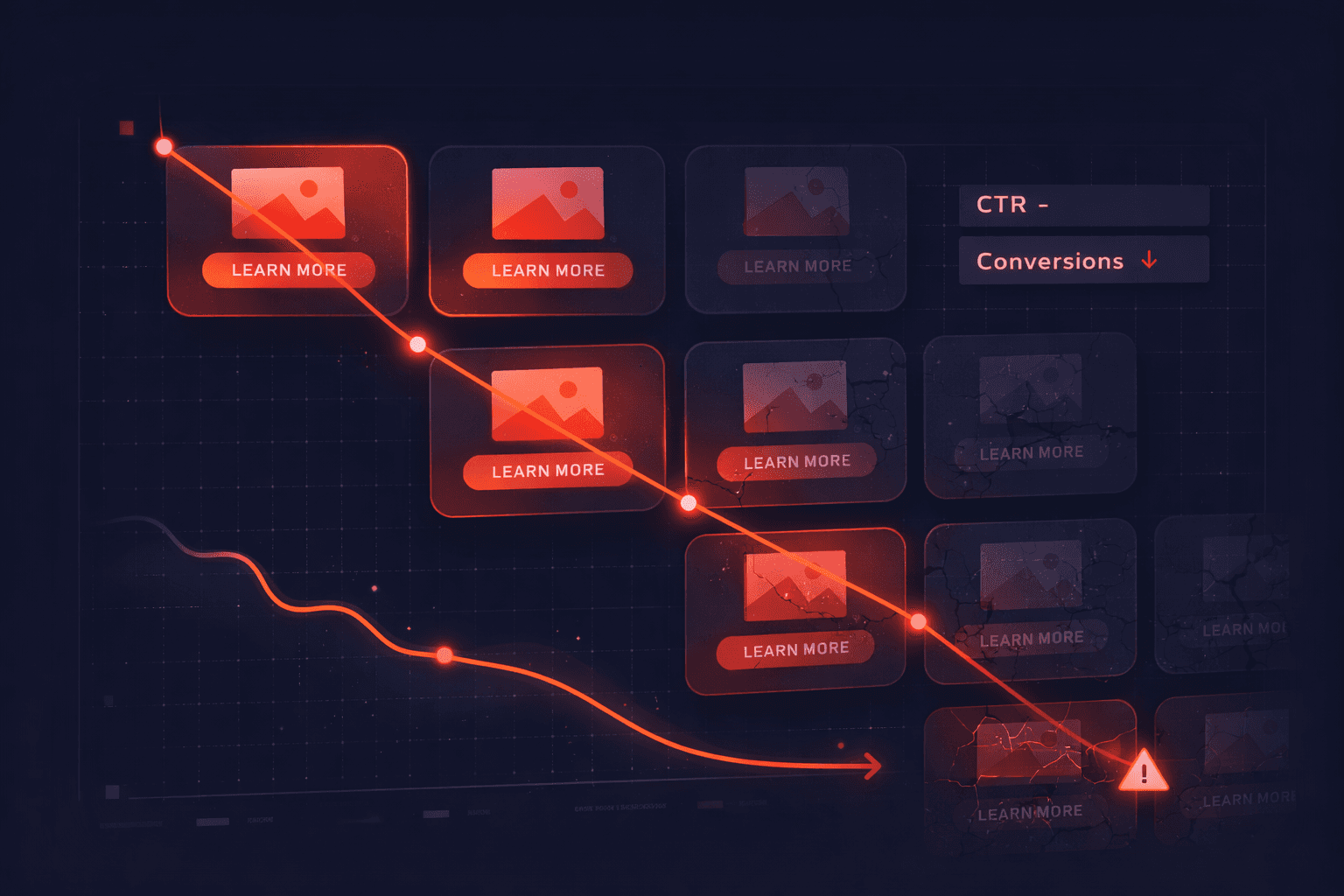
You've seen it happen. A new ad launches, performance spikes, and everyone celebrates. CTRs are up, CPAs are down, and conversions are flowing. Leadership asks: "Can we get more of this?"
So you scale. You increase spend, expand audiences, and let the winning creative run. Then, slowly but unmistakably, the metrics start sliding. Click-through rates drop. Cost per acquisition climbs. Engagement flatlines.
Welcome to ad fatigue—the silent budget killer that most brands don't catch until it's already cost them thousands.
Here's what makes ad fatigue particularly insidious: it doesn't announce itself. There's no algorithm notification, no platform warning. Your ads keep running, impressions keep accumulating, but performance erodes gradually enough that teams often miss it until quarterly reviews reveal the damage.
The data makes the problem clear. US consumers now spend more than eight hours daily with digital media, much of it on ad-supported platforms. They're drowning in advertising. Their attention spans are shrinking. And most brands keep recycling the same creative they've already seen dozens of times.
The result? Your audience has learned to tune you out before your message even registers.
But ad fatigue isn't inevitable. Brands that understand its root causes, monitor the right metrics, and build proactive creative refresh strategies can maintain performance even as campaigns scale.
Let's break down what ad fatigue actually is, what causes it, how to spot it early, and most importantly—how to prevent it from sabotaging your campaigns.
What Ad Fatigue Actually Is (And Why It's Not Just About Frequency)
Ad fatigue gets blamed on a lot of things, but the core issue is simpler than most marketers realize.
Ad Fatigue Defined
Ad fatigue is the measurable decline in campaign performance that occurs when audiences are overexposed to repetitive or stale advertising creative.
It manifests through declining engagement, rising costs, and diminishing returns on ad spend. The creative that once converted at 4% might drop to 2%, then 1%, while your CPA doubles or triples.
Why Ad Fatigue Isn't Just About Showing Too Many Ads
Most marketers assume ad fatigue is purely a frequency problem—that users have just seen the same ad too many times. That's part of it, but it's not the full story.
Ad fatigue happens when:
Users see the same creative repeatedly without variation
Creative becomes predictable and stops capturing attention
Messaging feels irrelevant to where the user is in their journey
Visuals and copy lack novelty and blend into the noise
You can show an ad 50 times without triggering fatigue if the creative varies enough to feel fresh. Conversely, users can become fatigued after just 3-5 exposures if the creative is generic, off-target, or visually stale.
Ad fatigue is as much about creative quality and variety as it is about frequency.
The Business Impact: More Than Just Vanity Metrics
Some marketers dismiss ad fatigue as a minor creative issue. The performance data tells a different story.
When ad fatigue sets in, you'll see:
Lower engagement rates – Clicks, likes, comments, and shares all decline
Higher customer acquisition costs – You're spending more to reach fewer qualified users
Wasted media spend – Budget continues flowing to creative that's no longer working
Declining ROAS – Return on ad spend erodes as efficiency drops
Audience burn-out – Users develop negative associations with your brand due to repetitive messaging
One B2C brand we worked with saw CPA increase 180% over six weeks because they kept scaling the same high-performing creative without variation. By the time they recognized the issue, they'd overspent by $47,000 on diminishing returns.
Ad fatigue doesn't just hurt your current campaign—it can damage brand perception and make future campaigns less effective.
The Root Causes of Ad Fatigue (And Which One Is Killing Your Performance)
Ad fatigue rarely has a single cause. Most often, it's the result of multiple factors compounding over time.
Cause 1: Creative Recycling Without Variation
The most common driver of ad fatigue is creative recycling—running the same visuals, copy, and messaging for too long.
Why this happens:
New creative production costs time and money
Teams want to maximize ROI from existing assets
High-performing creative gets scaled aggressively without refresh plans
Brands treat creative as a one-time investment rather than an ongoing system
Human brains crave novelty. When users encounter the same visual patterns repeatedly, their attention filters kick in and they scroll past without processing the message.
Even minor creative variations can reset attention and extend performance. Changing the background color, swapping out hero images, or testing new taglines can make the same core message feel fresh enough to re-engage fatigued audiences.
Cause 2: Narrow Audience Targeting Accelerates Fatigue
The smaller and more specific your audience, the faster you'll saturate it and trigger fatigue.
Consider two targeting scenarios:
Scenario A: Broad Targeting
Audience: Women 18-45 interested in fitness
Audience size: 8 million users
Time to saturation: Months
Scenario B: Narrow Targeting
Audience: Women 25-34, living in California, who engaged with your Instagram in the past 30 days
Audience size: 75,000 users
Time to saturation: Weeks (or even days with aggressive spend)
Narrow targeting is often necessary for retargeting, lookalike expansion, and high-intent conversion campaigns. But it concentrates your ad delivery on a smaller pool of users, which means they'll see your creative more frequently.
The strategic implication:
When running narrow-targeted campaigns, you need to refresh creative more frequently and build in more variation from the start. Broad awareness campaigns can sustain creative longer because they're constantly reaching new users.
Cause 3: Platform Algorithms Favor Your "Best" Creative (Until It's Not)
Most ad platforms—Meta, Google, TikTok—use optimization algorithms to serve what they determine is your best-performing creative to your target audience.
This creates a hidden problem:
If you upload five ad variants and one significantly outperforms the others, the algorithm will prioritize serving that single high-performer. This accelerates fatigue because the same creative dominates delivery.
Example from Meta Ads Manager:
You launch a campaign with five creative variants
Creative A achieves 3.2% CTR in the first 48 hours
Creatives B-E achieve 1.8-2.1% CTR
The algorithm allocates 70% of impressions to Creative A within a week
By week three, Creative A's performance has declined to 1.4% CTR due to fatigue
But the algorithm is still prioritizing it because it's the historical winner
This is especially problematic in "set and forget" campaigns that lack active management. The algorithm doubles down on what worked initially, even as performance deteriorates.
The solution isn't to fight the algorithm—it's to continuously feed it fresh creative so the "best performer" keeps changing.
How to Detect Ad Fatigue Before It Kills Your ROI
The best time to address ad fatigue is before it becomes a crisis. You can monitor these leading indicators with a timely comprehensive campaign audit.

Metric 1: Declining Click-Through Rate (CTR)
CTR is your most reliable early warning signal for ad fatigue.
What to monitor:
Week-over-week CTR trends
CTR decline without changes to budget, targeting, or bidding
Variance in CTR across creative variants
A performance tracking infrastructure can enable you to detect it early on.
Benchmark:
If CTR drops more than 15-20% from peak performance over a 2-3 week period without external factors (seasonality, competitive shifts), creative fatigue is likely the culprit.
Example:
Week 1: 2.8% CTR
Week 2: 2.5% CTR
Week 3: 2.1% CTR
Week 4: 1.6% CTR (43% decline)
This pattern signals clear creative fatigue. The audience has seen the ad too many times and stopped engaging.
Metric 2: Rising Cost Per Acquisition (CPA) and Cost Per Click (CPC)
As engagement declines, efficiency erodes. You're paying the same (or more) to reach users who are less likely to convert.
What to monitor:
CPA trending upward without changes to targeting or bidding strategy
CPC increasing as CTR declines (less competition from users clicking means you're paying more for fewer clicks)
Benchmark:
A 25-30% increase in CPA over 3-4 weeks typically indicates creative fatigue, especially if it correlates with declining CTR and engagement.
Metric 3: Engagement Rate Collapse
Beyond clicks, watch how users interact with your ads.
Key engagement signals:
Likes, comments, shares on social ads
Time spent on landing page after clicking
Video completion rates (for video ads)
Add-to-cart rates or other on-site actions
When users stop engaging with your ads but impressions remain high, it's a clear signal that creative has lost its impact.
Metric 4: Frequency Metrics (Platform-Specific)
Frequency measures the average number of times a user has seen your ad.
Meta and other platforms provide this metric directly in their dashboards.
Frequency benchmarks:
Frequency 1-3: Fresh engagement, minimal fatigue risk
Frequency 4-7: Monitor closely, fatigue risk increasing
Frequency 8+: High fatigue risk, creative refresh urgently needed
High frequency isn't inherently bad—retargeting campaigns often benefit from 5-10 exposures. But when frequency rises without corresponding conversion lift, you're wasting impressions on fatigued users.
Metric 5: Audience Sentiment (Qualitative Indicator)
Sometimes ad fatigue shows up in unexpected places.
Monitor:
Negative comments on ads ("I've seen this 1000 times")
Reduced time on site after clicking
Increase in ad hides or "stop seeing this ad" actions
These qualitative signals often precede quantitative declines, giving you an early chance to intervene.
The Strategic Framework: Preventing and Combating Ad Fatigue
Fighting ad fatigue isn't about constantly producing new creative. It's about building systems that keep your campaigns fresh and efficient over time.
Strategy 1: Build a Rolling Creative Refresh Calendar
The most effective defense against ad fatigue is planned obsolescence—knowing from the start that creative has a shelf life and planning systematic creative rotation accordingly.
How to implement:
Audit historical performance – Review past campaigns to understand how long creative typically stays effective in your category
Set refresh intervals – For most brands, refreshing creative every 4-6 weeks is a reasonable starting point
Pre-produce creative batches – Rather than scrambling when performance declines, produce creative in batches that can be rotated systematically
Automate rotation where possible – Use platform features like Meta's dynamic creative optimization to rotate elements automatically
Example:
An ecommerce brand produces 12 ad variants at the start of each quarter:
Weeks 1-3: Variants A-D in rotation
Weeks 4-6: Variants E-H in rotation
Weeks 7-9: Variants I-L in rotation
Weeks 10-12: Return to refreshed versions of top performers
This approach spreads production costs across the quarter while ensuring audiences never see the same creative long enough to burn out.
Strategy 2: Embrace Modular Creative Systems
You don't need to reinvent creative from scratch every time. Modular systems let you mix and match elements to create "new" ads efficiently.
What is modular creative?
Modular creative breaks ads into interchangeable components:
Visual elements: Hero images, product shots, backgrounds
Copy components: Headlines, body copy, CTAs
Format variations: Single image, carousel, video
Layouts: Text placement, color schemes, design templates
By maintaining a library of these components, you can rapidly assemble new combinations that feel fresh without requiring full creative production.
Example:
A SaaS brand maintains:
5 hero image variations
8 headline variations
6 body copy variations
3 CTA button options
This yields 720 unique ad combinations (5 x 8 x 6 x 3) that can be deployed as creative fatigue emerges.
Platform note: Meta's Advantage+ Creative and Google's responsive ads natively support modular approaches, automatically testing combinations and optimizing delivery.
Strategy 3: Segment Creative by Funnel Stage and Audience
Not all audiences should see the same creative—and rotating creative across segments extends campaign lifespan.
Funnel-based segmentation:
Top-of-funnel (awareness): Focus on brand storytelling, product education, and broad appeal
Mid-funnel (consideration): Highlight differentiation, customer proof, and value propositions
Bottom-of-funnel (conversion): Emphasize offers, urgency, and friction reduction
By tailoring creative to funnel stage, you reduce the risk of fatiguing audiences with irrelevant messaging.
Audience-based segmentation:
Cold audiences: Require education and trust-building
Warm audiences: Need reinforcement and differentiation
Retargeting audiences: Benefit from high-frequency, conversion-focused creative
Each segment can sustain different creative for different durations. Cold audiences have higher tolerance for repetition (since you're reaching new users), while retargeting audiences need more variation to avoid burnout.
Strategy 4: Integrate User-Generated Content (UGC)
UGC provides an endless stream of fresh, authentic creative without the cost of traditional production.
Why UGC combats fatigue:
Feels more authentic and less "ad-like"
Constantly renews as new customers share content
Builds social proof while keeping creative fresh
Lower production costs enable higher creative volume
How to source UGC:
Encourage customers to share product photos/videos with branded hashtags
Run contests or campaigns that incentivize content creation
Partner with micro-influencers to generate diverse creative angles
Use customer testimonials and reviews as ad copy
Pro tip: Combine UGC with modular creative systems. Use customer photos as hero images, then overlay your brand messaging, CTAs, and design elements to maintain brand consistency.
Strategy 5: Implement Always-On Creative Testing
Testing isn't a one-time exercise—it's a continuous process that identifies what's working and what's fatiguing.
Always-on testing framework:
Establish a testing budget – Allocate 10-15% of total media spend to creative experimentation
Launch test campaigns systematically – Introduce 2-3 new creative variants weekly or bi-weekly
Monitor performance against control – Compare new creative to your current top performer
Graduate winners, retire losers – Scale creative that outperforms the control, pause underperformers
Cycle tested creative into rotation – Proven winners enter your core rotation, while the control is retired before fatigue sets in
Tools that accelerate testing:
Platforms like Meta Ads Manager and Google Ads offer built-in A/B testing features, but third-party tools can provide deeper insights:
Polaris IQ Creative Accelerator – AI-powered testing that identifies high-performing creative faster
AdEspresso – Multi-variant testing and performance analytics
Smartly.io – Automated creative testing and optimization
Case example:
A D2C wellness brand implemented always-on testing and rotated creative every three weeks based on performance data. Over six months:
CTR improved 38% compared to prior "set and forget" approach
CPA decreased 22%
Creative production ROI increased 3x due to modular systems
Case Examples: Brands That Beat Ad Fatigue (And How They Did It)
Case 1: DTC Apparel Brand Implements Modular Creative System
Company Profile:
Industry: Direct-to-consumer fashion
Challenge: Rapid creative fatigue on Meta due to narrow retargeting audiences
Campaign objective: Lower CPA while maintaining conversion volume
The Problem:
The brand relied on 3-4 static ad creatives per campaign and ran them until performance collapsed. By the time they identified fatigue, CPA had risen 140% and ROAS had dropped from 4.2:1 to 1.8:1.
The Strategy:
The brand implemented a modular creative system:
Produced 20 product photography shots
Created 12 lifestyle/UGC-style images
Developed 10 headline variations and 8 body copy options
Built 5 design templates
Total: 960 unique ad combinations without requiring new photoshoots.
They rotated creative weekly using Meta's dynamic creative tools and set frequency caps at 5 impressions per user per week.
The Results:
CPA decreased 38% within 60 days
ROAS improved from 1.8:1 to 3.9:1
CTR stabilized at 2.4-2.7% (previously ranged from 0.8-3.5% depending on fatigue stage)
Creative production costs decreased 42% due to efficient asset reuse
Key Takeaway:
Modular creative systems don't require massive budgets—they require strategic planning. By breaking creative into components, brands can generate near-infinite variation without constant new production.
Case 2: SaaS Company Uses Always-On Testing to Prevent Fatigue
Company Profile:
Industry: B2B SaaS (HR software)
Challenge: Long sales cycles made it difficult to attribute creative performance
Campaign objective: Maintain consistent pipeline generation at stable CAC
The Problem:
The SaaS company ran campaigns for 3-6 months without creative updates. By the time they noticed CAC rising, they'd overspent by $60K on fatigued creative.
The Strategy:
The company implemented an always-on testing framework:
Allocated 15% of monthly budget ($12K) to creative testing
Introduced 3 new creative variants bi-weekly
Ran 7-day tests against current control
Graduated winners into main rotation, paused losers
Retired control creative after 4-6 weeks regardless of performance
The Results:
CAC reduced by 29% year-over-year
Pipeline quality improved (measured via lead scoring)
Creative refresh cycles shortened from 6 months to 3-4 weeks
Testing identified 12 winning creative themes that now form the foundation of their evergreen strategy
Key Takeaway:
Always-on testing isn't just about finding winners—it's about systematically preventing fatigue before it impacts results. By treating creative as a continuous input rather than a periodic project, brands maintain consistent performance.
Conclusion: Creative Fatigue Is a Systems Problem, Not a Creative Problem
Ad fatigue happens to every brand running paid campaigns at scale. The difference between brands that struggle with it and brands that manage it successfully isn't creative talent or budget—it's systems.
Here's what you need to remember:
Ad fatigue occurs when audiences are overexposed to repetitive creative. It manifests through declining CTR, rising CPA, and eroding ROAS. The root causes are creative recycling, narrow audience targeting, and algorithm optimization that favors historical winners.
The solution isn't to constantly produce expensive new creative from scratch. It's to build systems that keep campaigns fresh efficiently:
Implement rolling creative refresh calendars so you're never scrambling when performance drops
Use modular creative systems to generate variation without massive production costs
Segment creative by funnel stage and audience to extend campaign lifespan
Integrate user-generated content for authentic, renewable creative assets
Run always-on testing to identify winners and retire losers before fatigue sets in
The brands winning on paid media aren't the ones with the biggest creative budgets—they're the ones with the smartest creative systems.
Prevent Fatigue Before It Kills ROI
Most brands discover ad fatigue after performance has already tanked—when CTR collapses, CPAs spike, and budgets evaporate. By then, you're in reactive mode, scrambling for new creative while bleeding dollars on fatigued assets. The difference between systematic creative management and expensive firefighting is infrastructure: performance tracking that spots degradation early, creative testing frameworks that maintain a refresh pipeline, and measurement systems that distinguish fatigue from deeper funnel problems.
At Blend, we build paid social programs designed around proactive creative rotation—not reactive crisis management. We integrate the campaign audit methodologies that diagnose performance issues early with the analytics infrastructure that makes fatigue patterns visible before they destroy ROI. If your best creative is dying and you're not sure why, let's diagnose the real problem.
You've seen it happen. A new ad launches, performance spikes, and everyone celebrates. CTRs are up, CPAs are down, and conversions are flowing. Leadership asks: "Can we get more of this?"
So you scale. You increase spend, expand audiences, and let the winning creative run. Then, slowly but unmistakably, the metrics start sliding. Click-through rates drop. Cost per acquisition climbs. Engagement flatlines.
Welcome to ad fatigue—the silent budget killer that most brands don't catch until it's already cost them thousands.
Here's what makes ad fatigue particularly insidious: it doesn't announce itself. There's no algorithm notification, no platform warning. Your ads keep running, impressions keep accumulating, but performance erodes gradually enough that teams often miss it until quarterly reviews reveal the damage.
The data makes the problem clear. US consumers now spend more than eight hours daily with digital media, much of it on ad-supported platforms. They're drowning in advertising. Their attention spans are shrinking. And most brands keep recycling the same creative they've already seen dozens of times.
The result? Your audience has learned to tune you out before your message even registers.
But ad fatigue isn't inevitable. Brands that understand its root causes, monitor the right metrics, and build proactive creative refresh strategies can maintain performance even as campaigns scale.
Let's break down what ad fatigue actually is, what causes it, how to spot it early, and most importantly—how to prevent it from sabotaging your campaigns.
What Ad Fatigue Actually Is (And Why It's Not Just About Frequency)
Ad fatigue gets blamed on a lot of things, but the core issue is simpler than most marketers realize.
Ad Fatigue Defined
Ad fatigue is the measurable decline in campaign performance that occurs when audiences are overexposed to repetitive or stale advertising creative.
It manifests through declining engagement, rising costs, and diminishing returns on ad spend. The creative that once converted at 4% might drop to 2%, then 1%, while your CPA doubles or triples.
Why Ad Fatigue Isn't Just About Showing Too Many Ads
Most marketers assume ad fatigue is purely a frequency problem—that users have just seen the same ad too many times. That's part of it, but it's not the full story.
Ad fatigue happens when:
Users see the same creative repeatedly without variation
Creative becomes predictable and stops capturing attention
Messaging feels irrelevant to where the user is in their journey
Visuals and copy lack novelty and blend into the noise
You can show an ad 50 times without triggering fatigue if the creative varies enough to feel fresh. Conversely, users can become fatigued after just 3-5 exposures if the creative is generic, off-target, or visually stale.
Ad fatigue is as much about creative quality and variety as it is about frequency.
The Business Impact: More Than Just Vanity Metrics
Some marketers dismiss ad fatigue as a minor creative issue. The performance data tells a different story.
When ad fatigue sets in, you'll see:
Lower engagement rates – Clicks, likes, comments, and shares all decline
Higher customer acquisition costs – You're spending more to reach fewer qualified users
Wasted media spend – Budget continues flowing to creative that's no longer working
Declining ROAS – Return on ad spend erodes as efficiency drops
Audience burn-out – Users develop negative associations with your brand due to repetitive messaging
One B2C brand we worked with saw CPA increase 180% over six weeks because they kept scaling the same high-performing creative without variation. By the time they recognized the issue, they'd overspent by $47,000 on diminishing returns.
Ad fatigue doesn't just hurt your current campaign—it can damage brand perception and make future campaigns less effective.
The Root Causes of Ad Fatigue (And Which One Is Killing Your Performance)
Ad fatigue rarely has a single cause. Most often, it's the result of multiple factors compounding over time.
Cause 1: Creative Recycling Without Variation
The most common driver of ad fatigue is creative recycling—running the same visuals, copy, and messaging for too long.
Why this happens:
New creative production costs time and money
Teams want to maximize ROI from existing assets
High-performing creative gets scaled aggressively without refresh plans
Brands treat creative as a one-time investment rather than an ongoing system
Human brains crave novelty. When users encounter the same visual patterns repeatedly, their attention filters kick in and they scroll past without processing the message.
Even minor creative variations can reset attention and extend performance. Changing the background color, swapping out hero images, or testing new taglines can make the same core message feel fresh enough to re-engage fatigued audiences.
Cause 2: Narrow Audience Targeting Accelerates Fatigue
The smaller and more specific your audience, the faster you'll saturate it and trigger fatigue.
Consider two targeting scenarios:
Scenario A: Broad Targeting
Audience: Women 18-45 interested in fitness
Audience size: 8 million users
Time to saturation: Months
Scenario B: Narrow Targeting
Audience: Women 25-34, living in California, who engaged with your Instagram in the past 30 days
Audience size: 75,000 users
Time to saturation: Weeks (or even days with aggressive spend)
Narrow targeting is often necessary for retargeting, lookalike expansion, and high-intent conversion campaigns. But it concentrates your ad delivery on a smaller pool of users, which means they'll see your creative more frequently.
The strategic implication:
When running narrow-targeted campaigns, you need to refresh creative more frequently and build in more variation from the start. Broad awareness campaigns can sustain creative longer because they're constantly reaching new users.
Cause 3: Platform Algorithms Favor Your "Best" Creative (Until It's Not)
Most ad platforms—Meta, Google, TikTok—use optimization algorithms to serve what they determine is your best-performing creative to your target audience.
This creates a hidden problem:
If you upload five ad variants and one significantly outperforms the others, the algorithm will prioritize serving that single high-performer. This accelerates fatigue because the same creative dominates delivery.
Example from Meta Ads Manager:
You launch a campaign with five creative variants
Creative A achieves 3.2% CTR in the first 48 hours
Creatives B-E achieve 1.8-2.1% CTR
The algorithm allocates 70% of impressions to Creative A within a week
By week three, Creative A's performance has declined to 1.4% CTR due to fatigue
But the algorithm is still prioritizing it because it's the historical winner
This is especially problematic in "set and forget" campaigns that lack active management. The algorithm doubles down on what worked initially, even as performance deteriorates.
The solution isn't to fight the algorithm—it's to continuously feed it fresh creative so the "best performer" keeps changing.
How to Detect Ad Fatigue Before It Kills Your ROI
The best time to address ad fatigue is before it becomes a crisis. You can monitor these leading indicators with a timely comprehensive campaign audit.
Metric 1: Declining Click-Through Rate (CTR)
CTR is your most reliable early warning signal for ad fatigue.
What to monitor:
Week-over-week CTR trends
CTR decline without changes to budget, targeting, or bidding
Variance in CTR across creative variants
A performance tracking infrastructure can enable you to detect it early on.
Benchmark:
If CTR drops more than 15-20% from peak performance over a 2-3 week period without external factors (seasonality, competitive shifts), creative fatigue is likely the culprit.
Example:
Week 1: 2.8% CTR
Week 2: 2.5% CTR
Week 3: 2.1% CTR
Week 4: 1.6% CTR (43% decline)
This pattern signals clear creative fatigue. The audience has seen the ad too many times and stopped engaging.
Metric 2: Rising Cost Per Acquisition (CPA) and Cost Per Click (CPC)
As engagement declines, efficiency erodes. You're paying the same (or more) to reach users who are less likely to convert.
What to monitor:
CPA trending upward without changes to targeting or bidding strategy
CPC increasing as CTR declines (less competition from users clicking means you're paying more for fewer clicks)
Benchmark:
A 25-30% increase in CPA over 3-4 weeks typically indicates creative fatigue, especially if it correlates with declining CTR and engagement.
Metric 3: Engagement Rate Collapse
Beyond clicks, watch how users interact with your ads.
Key engagement signals:
Likes, comments, shares on social ads
Time spent on landing page after clicking
Video completion rates (for video ads)
Add-to-cart rates or other on-site actions
When users stop engaging with your ads but impressions remain high, it's a clear signal that creative has lost its impact.
Metric 4: Frequency Metrics (Platform-Specific)
Frequency measures the average number of times a user has seen your ad.
Meta and other platforms provide this metric directly in their dashboards.
Frequency benchmarks:
Frequency 1-3: Fresh engagement, minimal fatigue risk
Frequency 4-7: Monitor closely, fatigue risk increasing
Frequency 8+: High fatigue risk, creative refresh urgently needed
High frequency isn't inherently bad—retargeting campaigns often benefit from 5-10 exposures. But when frequency rises without corresponding conversion lift, you're wasting impressions on fatigued users.
Metric 5: Audience Sentiment (Qualitative Indicator)
Sometimes ad fatigue shows up in unexpected places.
Monitor:
Negative comments on ads ("I've seen this 1000 times")
Reduced time on site after clicking
Increase in ad hides or "stop seeing this ad" actions
These qualitative signals often precede quantitative declines, giving you an early chance to intervene.
The Strategic Framework: Preventing and Combating Ad Fatigue
Fighting ad fatigue isn't about constantly producing new creative. It's about building systems that keep your campaigns fresh and efficient over time.
Strategy 1: Build a Rolling Creative Refresh Calendar
The most effective defense against ad fatigue is planned obsolescence—knowing from the start that creative has a shelf life and planning systematic creative rotation accordingly.
How to implement:
Audit historical performance – Review past campaigns to understand how long creative typically stays effective in your category
Set refresh intervals – For most brands, refreshing creative every 4-6 weeks is a reasonable starting point
Pre-produce creative batches – Rather than scrambling when performance declines, produce creative in batches that can be rotated systematically
Automate rotation where possible – Use platform features like Meta's dynamic creative optimization to rotate elements automatically
Example:
An ecommerce brand produces 12 ad variants at the start of each quarter:
Weeks 1-3: Variants A-D in rotation
Weeks 4-6: Variants E-H in rotation
Weeks 7-9: Variants I-L in rotation
Weeks 10-12: Return to refreshed versions of top performers
This approach spreads production costs across the quarter while ensuring audiences never see the same creative long enough to burn out.
Strategy 2: Embrace Modular Creative Systems
You don't need to reinvent creative from scratch every time. Modular systems let you mix and match elements to create "new" ads efficiently.
What is modular creative?
Modular creative breaks ads into interchangeable components:
Visual elements: Hero images, product shots, backgrounds
Copy components: Headlines, body copy, CTAs
Format variations: Single image, carousel, video
Layouts: Text placement, color schemes, design templates
By maintaining a library of these components, you can rapidly assemble new combinations that feel fresh without requiring full creative production.
Example:
A SaaS brand maintains:
5 hero image variations
8 headline variations
6 body copy variations
3 CTA button options
This yields 720 unique ad combinations (5 x 8 x 6 x 3) that can be deployed as creative fatigue emerges.
Platform note: Meta's Advantage+ Creative and Google's responsive ads natively support modular approaches, automatically testing combinations and optimizing delivery.
Strategy 3: Segment Creative by Funnel Stage and Audience
Not all audiences should see the same creative—and rotating creative across segments extends campaign lifespan.
Funnel-based segmentation:
Top-of-funnel (awareness): Focus on brand storytelling, product education, and broad appeal
Mid-funnel (consideration): Highlight differentiation, customer proof, and value propositions
Bottom-of-funnel (conversion): Emphasize offers, urgency, and friction reduction
By tailoring creative to funnel stage, you reduce the risk of fatiguing audiences with irrelevant messaging.
Audience-based segmentation:
Cold audiences: Require education and trust-building
Warm audiences: Need reinforcement and differentiation
Retargeting audiences: Benefit from high-frequency, conversion-focused creative
Each segment can sustain different creative for different durations. Cold audiences have higher tolerance for repetition (since you're reaching new users), while retargeting audiences need more variation to avoid burnout.
Strategy 4: Integrate User-Generated Content (UGC)
UGC provides an endless stream of fresh, authentic creative without the cost of traditional production.
Why UGC combats fatigue:
Feels more authentic and less "ad-like"
Constantly renews as new customers share content
Builds social proof while keeping creative fresh
Lower production costs enable higher creative volume
How to source UGC:
Encourage customers to share product photos/videos with branded hashtags
Run contests or campaigns that incentivize content creation
Partner with micro-influencers to generate diverse creative angles
Use customer testimonials and reviews as ad copy
Pro tip: Combine UGC with modular creative systems. Use customer photos as hero images, then overlay your brand messaging, CTAs, and design elements to maintain brand consistency.
Strategy 5: Implement Always-On Creative Testing
Testing isn't a one-time exercise—it's a continuous process that identifies what's working and what's fatiguing.
Always-on testing framework:
Establish a testing budget – Allocate 10-15% of total media spend to creative experimentation
Launch test campaigns systematically – Introduce 2-3 new creative variants weekly or bi-weekly
Monitor performance against control – Compare new creative to your current top performer
Graduate winners, retire losers – Scale creative that outperforms the control, pause underperformers
Cycle tested creative into rotation – Proven winners enter your core rotation, while the control is retired before fatigue sets in
Tools that accelerate testing:
Platforms like Meta Ads Manager and Google Ads offer built-in A/B testing features, but third-party tools can provide deeper insights:
Polaris IQ Creative Accelerator – AI-powered testing that identifies high-performing creative faster
AdEspresso – Multi-variant testing and performance analytics
Smartly.io – Automated creative testing and optimization
Case example:
A D2C wellness brand implemented always-on testing and rotated creative every three weeks based on performance data. Over six months:
CTR improved 38% compared to prior "set and forget" approach
CPA decreased 22%
Creative production ROI increased 3x due to modular systems
Case Examples: Brands That Beat Ad Fatigue (And How They Did It)
Case 1: DTC Apparel Brand Implements Modular Creative System
Company Profile:
Industry: Direct-to-consumer fashion
Challenge: Rapid creative fatigue on Meta due to narrow retargeting audiences
Campaign objective: Lower CPA while maintaining conversion volume
The Problem:
The brand relied on 3-4 static ad creatives per campaign and ran them until performance collapsed. By the time they identified fatigue, CPA had risen 140% and ROAS had dropped from 4.2:1 to 1.8:1.
The Strategy:
The brand implemented a modular creative system:
Produced 20 product photography shots
Created 12 lifestyle/UGC-style images
Developed 10 headline variations and 8 body copy options
Built 5 design templates
Total: 960 unique ad combinations without requiring new photoshoots.
They rotated creative weekly using Meta's dynamic creative tools and set frequency caps at 5 impressions per user per week.
The Results:
CPA decreased 38% within 60 days
ROAS improved from 1.8:1 to 3.9:1
CTR stabilized at 2.4-2.7% (previously ranged from 0.8-3.5% depending on fatigue stage)
Creative production costs decreased 42% due to efficient asset reuse
Key Takeaway:
Modular creative systems don't require massive budgets—they require strategic planning. By breaking creative into components, brands can generate near-infinite variation without constant new production.
Case 2: SaaS Company Uses Always-On Testing to Prevent Fatigue
Company Profile:
Industry: B2B SaaS (HR software)
Challenge: Long sales cycles made it difficult to attribute creative performance
Campaign objective: Maintain consistent pipeline generation at stable CAC
The Problem:
The SaaS company ran campaigns for 3-6 months without creative updates. By the time they noticed CAC rising, they'd overspent by $60K on fatigued creative.
The Strategy:
The company implemented an always-on testing framework:
Allocated 15% of monthly budget ($12K) to creative testing
Introduced 3 new creative variants bi-weekly
Ran 7-day tests against current control
Graduated winners into main rotation, paused losers
Retired control creative after 4-6 weeks regardless of performance
The Results:
CAC reduced by 29% year-over-year
Pipeline quality improved (measured via lead scoring)
Creative refresh cycles shortened from 6 months to 3-4 weeks
Testing identified 12 winning creative themes that now form the foundation of their evergreen strategy
Key Takeaway:
Always-on testing isn't just about finding winners—it's about systematically preventing fatigue before it impacts results. By treating creative as a continuous input rather than a periodic project, brands maintain consistent performance.
Conclusion: Creative Fatigue Is a Systems Problem, Not a Creative Problem
Ad fatigue happens to every brand running paid campaigns at scale. The difference between brands that struggle with it and brands that manage it successfully isn't creative talent or budget—it's systems.
Here's what you need to remember:
Ad fatigue occurs when audiences are overexposed to repetitive creative. It manifests through declining CTR, rising CPA, and eroding ROAS. The root causes are creative recycling, narrow audience targeting, and algorithm optimization that favors historical winners.
The solution isn't to constantly produce expensive new creative from scratch. It's to build systems that keep campaigns fresh efficiently:
Implement rolling creative refresh calendars so you're never scrambling when performance drops
Use modular creative systems to generate variation without massive production costs
Segment creative by funnel stage and audience to extend campaign lifespan
Integrate user-generated content for authentic, renewable creative assets
Run always-on testing to identify winners and retire losers before fatigue sets in
The brands winning on paid media aren't the ones with the biggest creative budgets—they're the ones with the smartest creative systems.
Prevent Fatigue Before It Kills ROI
Most brands discover ad fatigue after performance has already tanked—when CTR collapses, CPAs spike, and budgets evaporate. By then, you're in reactive mode, scrambling for new creative while bleeding dollars on fatigued assets. The difference between systematic creative management and expensive firefighting is infrastructure: performance tracking that spots degradation early, creative testing frameworks that maintain a refresh pipeline, and measurement systems that distinguish fatigue from deeper funnel problems.
At Blend, we build paid social programs designed around proactive creative rotation—not reactive crisis management. We integrate the campaign audit methodologies that diagnose performance issues early with the analytics infrastructure that makes fatigue patterns visible before they destroy ROI. If your best creative is dying and you're not sure why, let's diagnose the real problem.
Written by
Dylan Fields
When not hard at work, Danny can be found enjoying the outdoors, seeing live music, and exercising. Danny is passionate about data-informed decisions and strongly believes in implementing cohesive measurement frameworks to ensure all media is accountable for driving business outcomes. Throughout his career, he has developed full-funnel media strategies to drive both Brand Awareness and Growth objectives. He also loves ideating and activating first-to-market opportunities for clients to help brands stay innovative and at the forefront of their vertical.
More articles by
Dylan Fields





You might also like…

+91 6366 298 298

We blend together standout marketing strategies, create memorable branding, and deliver sleek web designs
+91 6366 298 298
We blend together standout marketing strategies, create memorable branding, and deliver sleek web designs
+91 6366 298 298
We blend together standout marketing strategies, create memorable branding, and deliver sleek web designs
+91 6366 298 298
We blend together standout marketing strategies, create memorable branding, and deliver sleek web designs